

Each week I pick a handful of stories, from gene editing and brain interfaces to climate adaptation and life in space, that show tomorrow’s world already taking shape, and think through what they might mean for how we’ll live.
1. Organs kept alive outside the body
Surgeons in Sydney say they have kept a donated human liver alive outside the body for seven weeks, smashing the previous record of about two weeks. Carlo Pulitano’s team at Royal Prince Alfred Hospital connected it to automated pumps and sensors, which he likens to “an artificial body”, that feed it blood and nutrients and clear away waste - a process known as perfusion. A Sydney trial is planned to transplant livers perfused for four days. Picture organs repaired, or even grown, on the bench and kept alive until needed. Source: MIT Technology Review
Bigger picture: Organs are scarce and time-critical. In the US, 109,817 people are on the national transplant waiting list and 12 people die each day waiting (organdonor.gov). The team’s conference abstract reports eight livers perfused on the system, all recovering function within 24–48 hours, with the longest surviving 47 days (TTS 2026). Perfusion is already going mainstream: one Oklahoma surgeon says about half the kidneys he transplants are now perfused, but which can add $100,000 to the cost of a transplant (MIT Technology Review).
Questions: If organs can live for months outside the body, could we repair donor organs, or even grow new ones, instead of waiting on a list?
2. Food from air
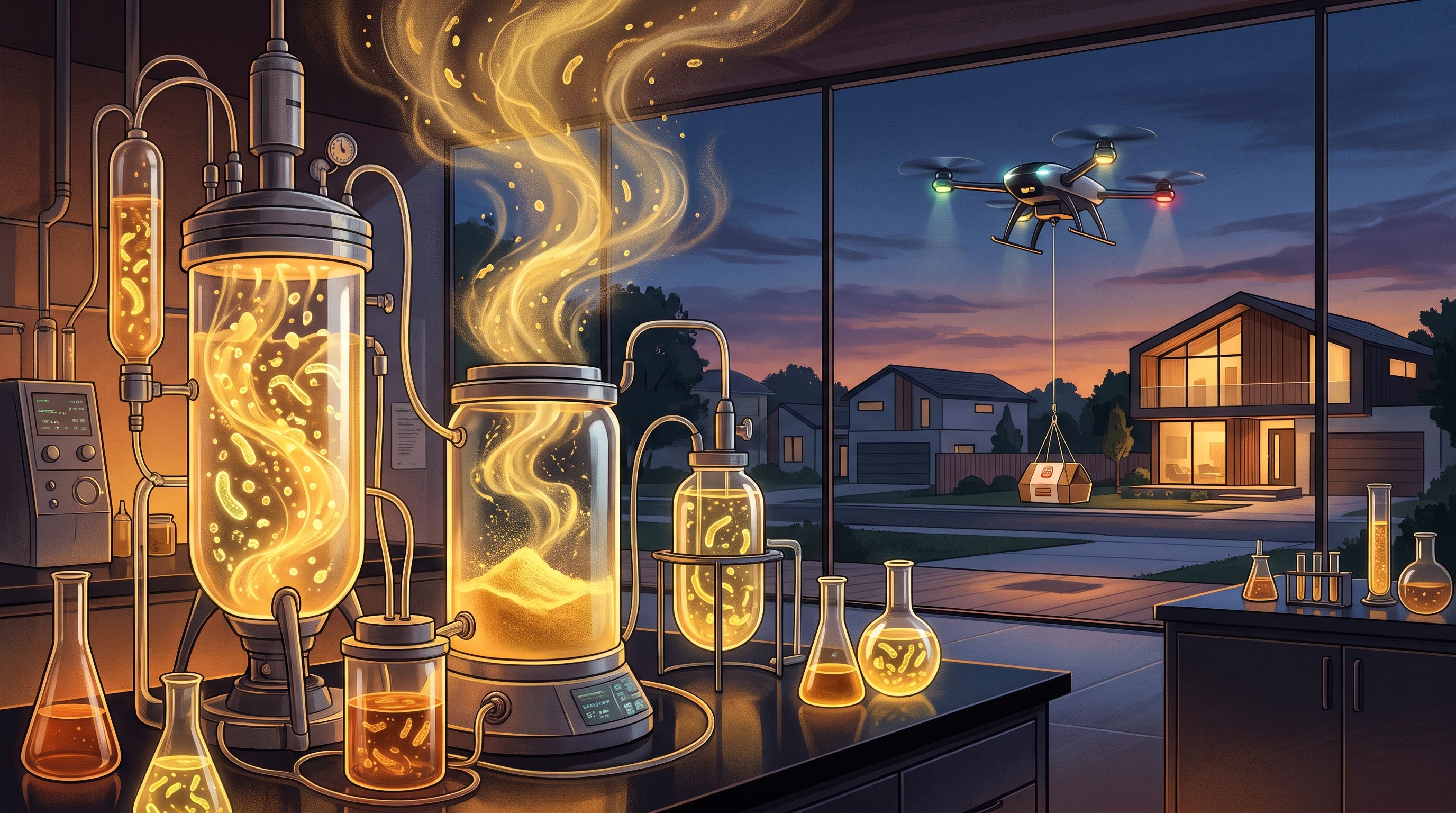
Finland’s Solar Foods has won a positive safety opinion from the European Food Safety Authority for Solein, a yellow protein powder made by feeding microbes carbon dioxide, hydrogen and oxygen. The powder is 78% protein and needs no farmland, irrigation, fertiliser or pesticides. Solar Foods expects full EU approval to take seven to nine months. Its demo plant in Vantaa targets 230 tonnes this year; a second factory due in 2028 would make 12,800 tonnes a year. Picture protein brewed from air and electricity. Source: Green Queen
Bigger picture: Food production is responsible for about 26% of global greenhouse gas emissions (Our World in Data), and half of the world’s habitable land is used for agriculture (Our World in Data). Climate impacts are a massive threat to food supply chains and agriculture productivity. Solar Foods says Solein generates just 1% of the greenhouse gases of meat and 20% of those of plant proteins, and because it isn’t tied to soil or seasons it could be made in the desert, the Arctic or even space (Green Queen).
Questions: If protein can be brewed from air and electricity, what happens to farmland, and to farmers?
3. The collapsing cost of getting to orbit
SpaceX’s Starship reached orbit on its 15th flight on 13 November, released 26 Starlink satellites and circled the Earth 14 times. The next day the ship flew back to Starbase in Texas and was caught by the launch tower’s “chopstick” arms for the first time. The Super Heavy booster ran low on fuel and was lost in the Gulf. Catching both stages is the key to full reuse, and to slashing the cost of reaching orbit. Picture rockets turned around like airliners. Source: Spaceflight Now
Bigger picture: Reuse is collapsing the cost of reaching orbit. In inflation-adjusted 2021 dollars, CSIS estimates the Space Shuttle cost about $65,400 per kilogram to low Earth orbit, against $2,600 for Falcon 9 and $1,500 for Falcon Heavy (CSIS). Elon Musk told the Baron Investment Conference on 6 November, “I think we’ll get to under $100 a kilogram to orbit,” a target for a fully reusable Starship rather than a price anyone can buy today (conference remarks). Volume is already surging: mass launched to orbit grew 31% in 2025 to 2,730 tonnes, with Starlink satellites making up 70% of it (ESA).
Questions: If a kilogram to orbit becomes cheaper than air freight, what do we build up there first, and who gets to decide?
4. Takeaway by drone
Uber Eats customers in Spring, a Houston suburb, can now have their order delivered by a Zipline drone, from 8am to 10pm. It is the first time Zipline has been fully built into another company’s app.Dallas is next, and the partners are aiming for 1 million Uber Eats drone deliveries a day across the US by the end of 2029. Picture dinner arriving by air before you’ve set the table. Source: Axios
Bigger picture: Delivery is becoming a mix of couriers, sidewalk robots and drones. Zipline says its drones have flown more than 140 million miles and made more than 3 million deliveries (Zipline). Google-owned Wing already offers drone delivery in nearly 20 US markets, and Amazon expects Prime Air to deliver half a billion packages by the end of the decade (Axios).
Questions: How are we going to manage the airspace over our streets and homes?
5. A decentralised grid with a battery for every home
National Grid is giving 125 low-income households in Fall River, Massachusetts, a free home battery with at least four hours of backup power, plus $150 a year for five years. Haven Energy installs and maintains the batteries and shares their stored power with the grid when demand peaks. If it works, it could become a model across the state. Picture every home as a small power station. Source: Canary Media
Bigger picture: Outages swing hugely from year to year. Counting major events, the average US electricity customer was without power for 662.6 minutes, about 11 hours, in 2024, against 269.2 minutes in 2025 (EIA). Households are adding storage anyway: US homes installed 746 MWh of batteries in Q3 2026, the largest third quarter on record, and SEIA projects just under 3 GWh for the full year (SEIA).
Questions: If our homes store and trade power, do we still need one big grid, or a network of millions of small ones?
Quotation of the week
“Precisely because scientific progress is a supreme achievement of human intelligence, it must not be confused with a privilege reserved for millionaires seeking immortality, while entire peoples suffer from poverty and oppression.”
— Pope Leo XIV, speaking at Santo Toribio de Mogrovejo Catholic University in Chiclayo, Peru (Holy See Press Office, 13 November 2026)
If something here made you think, please pass it on and share your thoughts. You can subscribe and read past issues at livinginthefuture.blog.