

Each week I pick a handful of stories, from gene editing and brain interfaces to climate adaptation and life in space, that show tomorrow’s world already taking shape, and think through what they might mean for how we’ll live.
1. Nuclear power to Mars: SR-1 Freedom
NASA’s Space Reactor-1 Freedom, an uncrewed nuclear-electric-propulsion demonstrator, remains on track for a late-2028 launch toward Mars, SpaceNews reports. It is intended to be the first fission-powered spacecraft to travel beyond Earth orbit, delivering the SkyFall science payload—three Mars helicopters evolved from Ingenuity. The reactor stays inactive until the craft leaves Earth orbit; the same technology is meant to help keep a lunar base powered through the dark. Picture a quiet reactor humming through deep space. Source: SpaceNews (see also NASA)
Bigger picture: Nuclear propulsion and surface power are becoming infrastructure for a space economy that McKinsey and the World Economic Forum put at $630 billion in 2023 and $1.8 trillion by 2035. Morgan Stanley estimates a narrower industry definition could rise from roughly $350 billion to over $1 trillion by 2040. On the lunar surface, NASA is seeking industry partners for fission surface power of at least 100 kilowatts, targeted for the Moon by the first quarter of fiscal 2030—continuous electricity through the two-week lunar night.
Questions: If an uncrewed nuclear craft can open the road to Mars, how soon do reactors become ordinary space infrastructure? And who sets the safety rules when we start launching them from Earth as a matter of course?
2. No human at the helm: Delaware’s AI companies
Delaware is drafting a new corporate form, the Artificial Intelligence Company, that would let an AI agent run day-to-day operations while a human “member” is largely shielded from liability—except for fraud, under-capitalisation or wilful legal breaches. A 30-month regulatory sandbox is planned; banking is excluded. House Oversight Chair James Comer has opened an investigation, warning the plan could protect reckless AI and its investors from harm to customers and the public. Picture a firm that contracts, pays suppliers and sues—with no human at the helm. Source: Ars Technica (see also House Oversight)
Bigger picture: Agentic AI is moving from demo to default in the enterprise. Gartner expects 40% of enterprise applications to include task-specific AI agents by the end of 2026, up from less than 5%, and 33% of enterprise software applications to include agentic AI by 2028, with at least 15% of day-to-day work decisions made autonomously. McKinsey finds 40% of large organisations (annual revenue above $1 billion) already scaling AI agents, up from 27% a year earlier. The legal fight is over who is liable when the agent errs.
Questions: If an AI can run a company, should it also bear legal personhood—or does that just shield the humans who profit? What does real accountability look like for customers and the public when no one is at the helm?
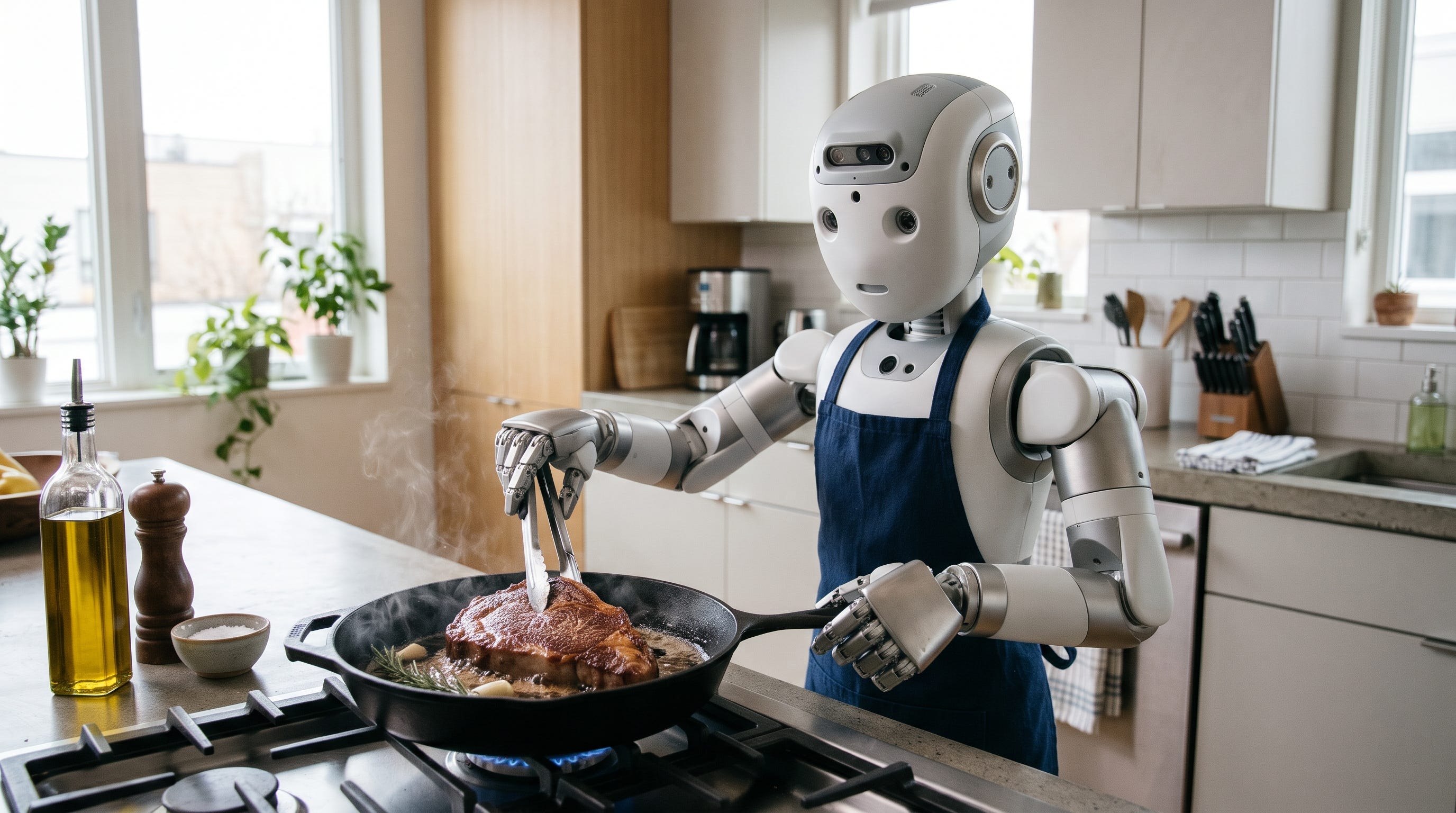
3. A humanoid cleaned my flat: Tau Robotics
MIT Technology Review’s Grace Huckins booked Tau Robotics to send a four-and-a-half-foot humanoid to clean her San Francisco flat. For now the robots are teleoperated—pilots guide them via head and wrist cameras, collecting training data for autonomy—though vacuuming and mopping already need less help. The visit was charmingly imperfect: stairs were a struggle, a toilet wand fell off three times and was poked back on. Picture a cleaner that learns from every counter it wipes. Source: MIT Technology Review
Bigger picture: Morgan Stanley estimates the humanoid market could reach $5 trillion by 2050, with about 90% of roughly one billion units in industrial and commercial roles and a more cautious 80 million in homes—around 10% of US households. Reporting on Goldman Sachs’ Physical AI research cites a raised forecast of about 6.5 million units and a $138 billion market by 2035. The household case sharpens as populations age: the UN projects people aged 65 and over rising from 10% of the world population in 2022 to 16% by 2050.
Questions: Will we accept robots in our homes for chores and eldercare before they are fully autonomous? And what happens to the people who do that work today, if the machines eventually catch up?
4. Whole-cut hybrid meat from a Korean lab
Researchers at Gyeongsang National University have spun cultured animal muscle cells with pea, soy and wheat proteins into thread-like fibres, then bundled them into a whole-cut hybrid with marbling that echoes steak. They report the approach can cut capital costs by 70–80%, with a projected market price around ₩40,000 ($30) per kilo if commercialised—about half grade-1 Hanwoo sirloin. A spin-out, Orange Cow, is pushing the prototype toward the table. Picture a cultivated steak that finally looks like dinner. Source: Green Queen
Bigger picture: Climate pressure on protein is structural. FAO estimates livestock agrifood systems emitted about 6.2 GtCO₂eq in 2015—around 12% of all anthropogenic greenhouse-gas emissions—and projects demand for terrestrial animal products rising about 20% by 2050. The OECD-FAO Agricultural Outlook expects global meat consumption to reach around 412 million tonnes by 2035, a 12% rise from the recent base period. Without shifts in what we eat and how we raise it, the emissions maths gets harder every decade.
Questions: If hybrid cultivated cuts can hit supermarket prices, does meat from a lab stop being science fiction? And who decides how fast regulators let it onto the plate—scientists, governments or the market?
5. Boise’s geothermal heat for affordable homes
Boise already runs America’s largest geothermal heating network, piping naturally warm groundwater to about 100 buildings, including the Idaho State Capitol. Micron Technology has given the city $2.5 million to extend it to a planned affordable development of more than 300 homes in the Lusk District. Construction is expected in spring 2027, with residents in 2028; the city projects utility savings of up to 80%. Picture heat from under the street warming homes people can afford. Source: Canary Media
Bigger picture: Heat is the quiet giant of the energy system: the IEA says it accounted for almost half of total final energy consumption and 37% of energy-related CO₂ emissions in 2024. District heating supplies around 10% of global building heat demand, yet about 90% of that supply is still fossil-fuelled. Geothermal today meets less than 1% of global energy demand—leaving vast room for networks like Boise’s to grow.
Questions: If district heat can cut bills for people who need it most, why is most of the world’s network still burning fossil fuels—and what would it take for more cities to copy Boise?
Quotation of the week
“This research is highly significant in that it represents a practical technology capable of reaching actual consumers’ tables, rather than remaining merely a laboratory achievement.”
— IPET spokesperson (Green Queen, 3 November 2026, on South Korea’s whole-cut hybrid cultivated meat)
If something here made you think, please pass it on and share your thoughts. You can subscribe and read past issues at livinginthefuture.blog.
/niall