

“The future is already here, it’s just not evenly distributed.” - William Gibson
Each week I pick a handful of stories, from gene editing and brain interfaces to climate adaptation and life in space, that show tomorrow’s world already taking shape, and think through what they might mean for how we’ll live.
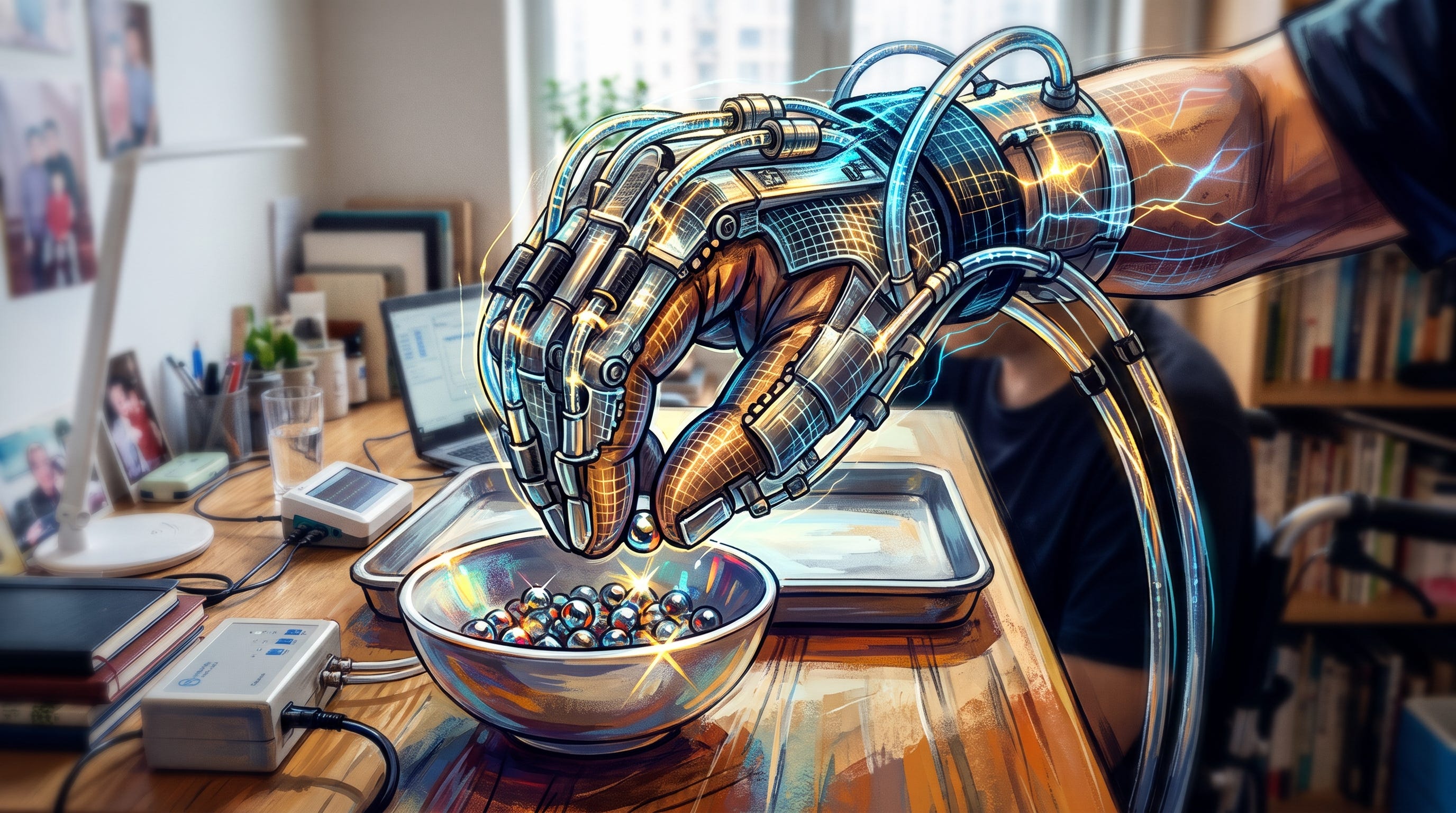
1. A brain chip that moves a hand
Two years after a coin-sized implant was placed over his sensorimotor cortex at Shanghai’s Huashan Hospital, a man paralysed in a 2020 car crash can now pinch small glass and steel beads. Neuracle’s NEO sits outside the dura, reads his intention to grasp and drives a pneumatic glove; he trains at home for about 90 minutes a day. Approved in March as the world’s first commercial invasive BCI, NEO had 12 commercial implants by early November. Picture rehab that happens at your desk. Source: Yicai (Chinese), see also Reuters
Bigger picture: Brain-computer interfaces are moving from lab demos to products. The WHO estimates 15.4 million people were living with spinal cord injury in 2021. In NEO’s 32-person confirmatory trial, 81.3% of participants showed a clinically meaningful improvement in unaided grip at 12 months (Yicai). Morgan Stanley puts the US addressable market at around $400 billion, but projects only about $1.5 billion of revenue through 2035 and a $1 billion annual run rate by 2041 (MassDevice). The need is vast; adoption will be slow.
Questions: If a brain chip can give back a grip today, how long before BCIs move from rehab into the devices we all use?
2. Fixing the ageing egg
Over 20% of egg cells in women in their 20s carry the wrong number of chromosomes, rising to 50% over 40, according to The Economist. Two European start-ups are tackling the cause. In lab tests, Shugoshin 1 protein based Ovo Labs’ EmbryoProtect 1 more than doubled the share of chromosomally normal eggs from women aged 34–40. Oxford-based U-Ploid says its molecule Lyvanta almost doubled the number that matured normally. Neither has yet shown more pregnancies. Picture IVF that repairs eggs rather than just selecting them. Source: The Economist
Bigger picture: We are having children later, and biology hasn’t caught up. The WHO estimates that around 17.5% of adults experience infertility, roughly 1 in 6 people worldwide. Women having their first child in 2024 were on average 29.9 years old in the EU (Eurostat). Treatments that tackle egg quality directly would shift fertility from a race against the clock to something medicine can modify.
Questions: If eggs can be repaired, does the biological clock stop dictating when we have families?
3. A robot builds in orbit
A robot has built a structure in space for the first time with no human at the controls. Caltech’s DARPA-funded ASTRA, launched in March on a Momentus space tug, picked struts and joints from dispensers to assemble bays of a 1.4-metre reflector antenna from composite tubes, aluminium joints and Kapton film. Engineers had just 15 minutes of contact a day. Not a brilliant worker though, with only the first section finished in time. Picture satellites launched as flat-packs and assembled where they will work. Source: Space.com (see also Caltech)
Bigger picture: Building in orbit frees designs from what fits inside a rocket fairing. DARPA describes the goal as space systems “transported as a box of building materials and assembled where they will operate” (DARPA). Soon we might be gathering materials from asteroids for an assembly value chanin in orbit.
Questions: If robots can assemble structures in orbit, are we accelerating toward Dyson sphere-like structures around our planet? As we crowd low Earth orbit with more hardware, who takes responsibility for keeping it usable for everyone?
4. Cameras that call the drones
Pano AI, whose AI cameras watch more than 95 million acres across 18 US states for smoke, has opened its platform to drone makers. Under its Drone Partner Program, a verified detection and its triangulated coordinates can go straight to aircraft instead of waiting on a dispatcher. Seneca’s autonomous aircraft, each rated for more than 100 pounds of suppressant, now respond for Colorado’s Aspen Fire Protection District. Picture a fire attacked minutes after it starts. Source: DroneXL
Bigger picture: Wildfire adaptation is shifting towards distributed sensors and machines on standby close to where fires start. UNEP projects extreme fires rising by up to 14% by 2030, 30% by 2050 and 50% by 2100. In California, wildfire-related costs passed from utilities to ratepayers grew from $488 million in 2019 to nearly $9 billion in 2024, and homeowner insurance premiums rose 84% from 2020 to 2026 (Stanford Climate and Energy Policy Program).
Questions: How do we feel about drones being dispatched automatically with no human in the decision making loop?
5. AI tutors as good as a human
In a 10-week trial with 1,179 students in 10 UK schools, London start-up Eedi and Google DeepMind found their AI maths tutor matched expert human tutors at fixing mistakes in the moment. Tutored students answered follow-up questions correctly 56–58% of the time, against 43% with standard in-app help. But neither AI nor human tutoring lifted scores on a broad standardised test, and boys seemed to benefit less than girls. Human tutors approved 94.7% of the AI’s messages unchanged. Picture a patient tutor for every pupil. Source: The 74
Bigger picture: Personal tutoring has always been the preserve of those who can afford it, and teachers are scarce. UNESCO says the world needs 44 million additional primary and secondary teachers by 2030, including 15 million in sub-Saharan Africa (UNESCO). Eedi has already started a larger trial with more than 15,000 students in which the AI talks to pupils directly, with humans stepping in only if a conversation goes wrong (The 74).
Questions: Are AI tutors the future of massively personalised education available to any child with access to a smartphone?
Quotation of the week
“[AI tutoring is] great to support students who are already motivated, but we need to figure out how to motivate students who aren’t motivated in the first place.”
— Bibi Groot, chief impact officer at Eedi (The 74, 29 October 2026)
If something here made you think, please pass it on and share your thoughts. You can subscribe and read past issues at livinginthefuture.blog.